Allow me to introduce myself!
I have worked for over 25 years as a primary school teacher, working in every year group at some point during this time. This has given me very valuable experience and insight into how children learn best at different stages of their school journey.
For more than half of my career I have worked as Special Educational Needs And Disabilities Coordinator. This has helped me develop my knowledge and understanding of the psychology of how children learn along with its practical implications for their curriculum.
At the same time, I have continued to be actively involved in both composing and performing, ensuring that I have some current working experience of the demands associated with a career in music.
All of this practical and theoretical knowledge has been put good use in formulating each iteration of my Primary Music Scheme of Work, the latest of which was adjudged to be ‘Outstanding’ by Ofsted in April 2024.
Some quotes from the team’s feedback:
“Singing and music are at the heart of this school.”
“Children are accomplished performers and clearly enjoy music.”
“The Music curriculum is broad and balanced and sticky knowledge is secure.”
The scheme is designed to be used by ‘non-music-specialist’ teachers who form the majority of the primary teaching workforce.
It is a very practical, hands on approach which aims to develop the children’s:
- Singing
- Instrumental skills
- Compositional skills
- Individual and ensemble performance skills
- Analytical listening skills
- Knowledge of the historical development of music, along with exploring some key works
- Knowledge of how music has been used in different ways across the centuries
- Knowledge of music of different cultures
- Engagement with the ‘Big Questions’ surrounding music, such as ‘Will computers ever replace human composers?’
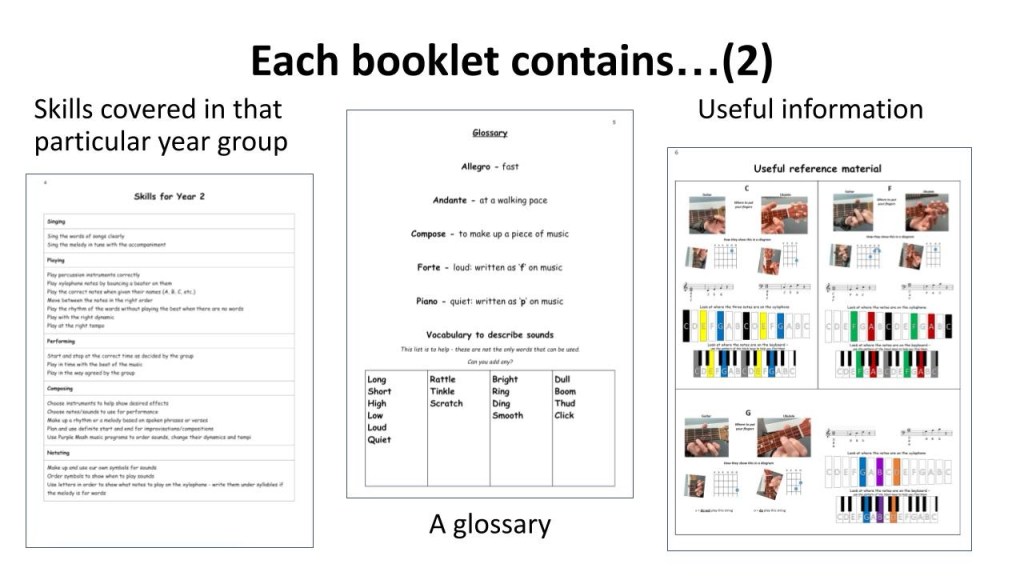
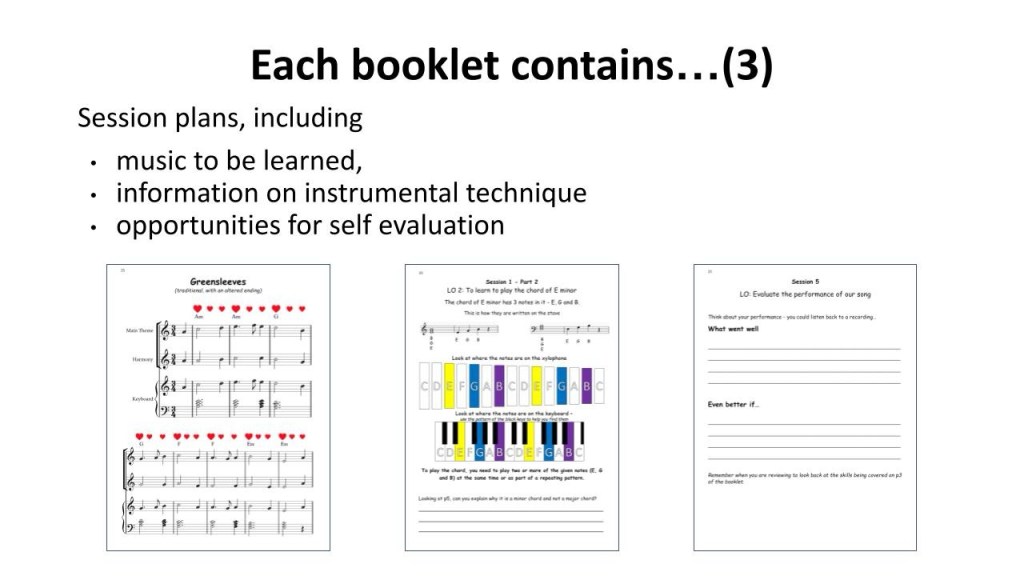
Each child has their own music booklet each term containing:
- the learning objectives to be covered
- a simple glossary for reference
- information about any listening material
- musical exercises to develop their playing skills
- the term’s performance and composition challenges


Instruments required for the optimal delivery of the scheme:
- Variety of different sized unpitched percussion:
– Hitting
– Scraping
– Shaking
– Tapping - Small 15 note xylophones
- Soprano xylophone
- Soprano metallophone
- Alto xylophone
- Alto metallophone
- Bass xylophone/metallophone
- Recorders (for all Y3)
- Keyboards
- Guitars (half size)
- Ukuleles
Children receiving private instrumental lessons are encouraged to bring their own instruments to use during lessons.
Occasionally Asked Questions
Upon what is the scheme based, and how is it kept ‘at the cutting edge’?
- It is based on four strands:
- music/education writing;
- 25+ years of practical classroom experience across the primary age range;
- support and training from Bolton Music Service;
- input from children
- I regularly compose and perform – this current experience has helped me ensure any learning is based on ‘real world’ practice
How is the scheme memorable?
- It is a very ’hands-on’ curriculum, with lots of opportunities to play and sing
- It embraces music technology
- Music booklets provide reference materials to which children are encouraged to refer on a regular basis, in order to build good habits
- It covers a wide variety of styles, including film, television and computer game music
- It allows children to share their own musical tastes
- It incorporates many opportunities to experience live music through taking part in and enjoying live music performances
- It encourages links to the local high school – showing what the children can look forward to
How is it relevant to the children?
- It has a local dimension, where children learn about the local ‘offer’
- They also take part in community music events, such as carol concerts/singing
- They also find out about local musicians and composers
- It has a national dimension, where children explore the wide range of music enjoyed by different communities around the United Kingdom
- It has an international dimension, where children consider the music of other cultures and also the interactions (both positive and negative) of ‘western’ traditions with these
- It encourages children to explore and share music of their own cultures, encouraging integration
- Their voice is taken into account when planning and updating the scheme
How do skills build?
- The curriculum is ‘circular’, meaning skills are regularly revisited and links are made to new skills
- Skill progression is made from small well-charted steps
- It is recognised that successful learning is based on lots of practice: as such, there is no rush to learn a new skill every week – time is given for skills to be practiced over and over again in a variety of contexts
- Also, skill acquisition is not a linear process – it is also recognised that initial successes may seem to ‘disappear’, but that perseverance will lead to deeper learning eventually becoming apparent
How is a high standard established and maintained?
- The overall expectations for each topic are set high to begin with
- Learning materials such as videos and backing tracks demonstrating the high standards are provided
- These videos are also useful staff training materials
- Half-termly performances give children something at which to aim
- Self-review in a supportive environment is developed and children are encouraged to set their own goals based on the high standards of the scheme
How are different abilities/attainments catered for?
- The instruments that the children are given the opportunity to learn (keyboard, percussion, string and wind) allow for a variety of different aptitudes to be catered for
- As skills progress in simple steps, children’s development along this continuum can be charted and tasks adapted as necessary
- Within lessons, the part that the children play can be adapted to be more or less challenging depending on their current attainment
- Adult and peer support is available in all lessons
How is it assessed?
- Teachers monitor progress through a combination of observation and questioning within lessons, allowing for immediate feedback and adjustments to be made, and ongoing (formative) assessment to take place
- Half-termly performances also provide (summative) assessment opportunities
Can the scheme be successfully implemented with fewer instrumental resources?
- Probably, so long as the children have access to instruments where they can learn to play melodies and chords
- Music hubs can provide support in applying for grants to buy instruments
- They may occasionally be able to loan out some instruments
- Fund-raising projects to help purchase instruments can also help raise the profile of music in the school – and also the school in the community
- Instruments last a good number of years – a £500 outlay may eventually work out at less than £50 a year investment…
To contact Mike regarding this scheme of work, or with any other queries regarding purchasing, performing or commissioning music, email him at:-
contact@mikestubbscomposer.com
 Mike Stubbs, Composer