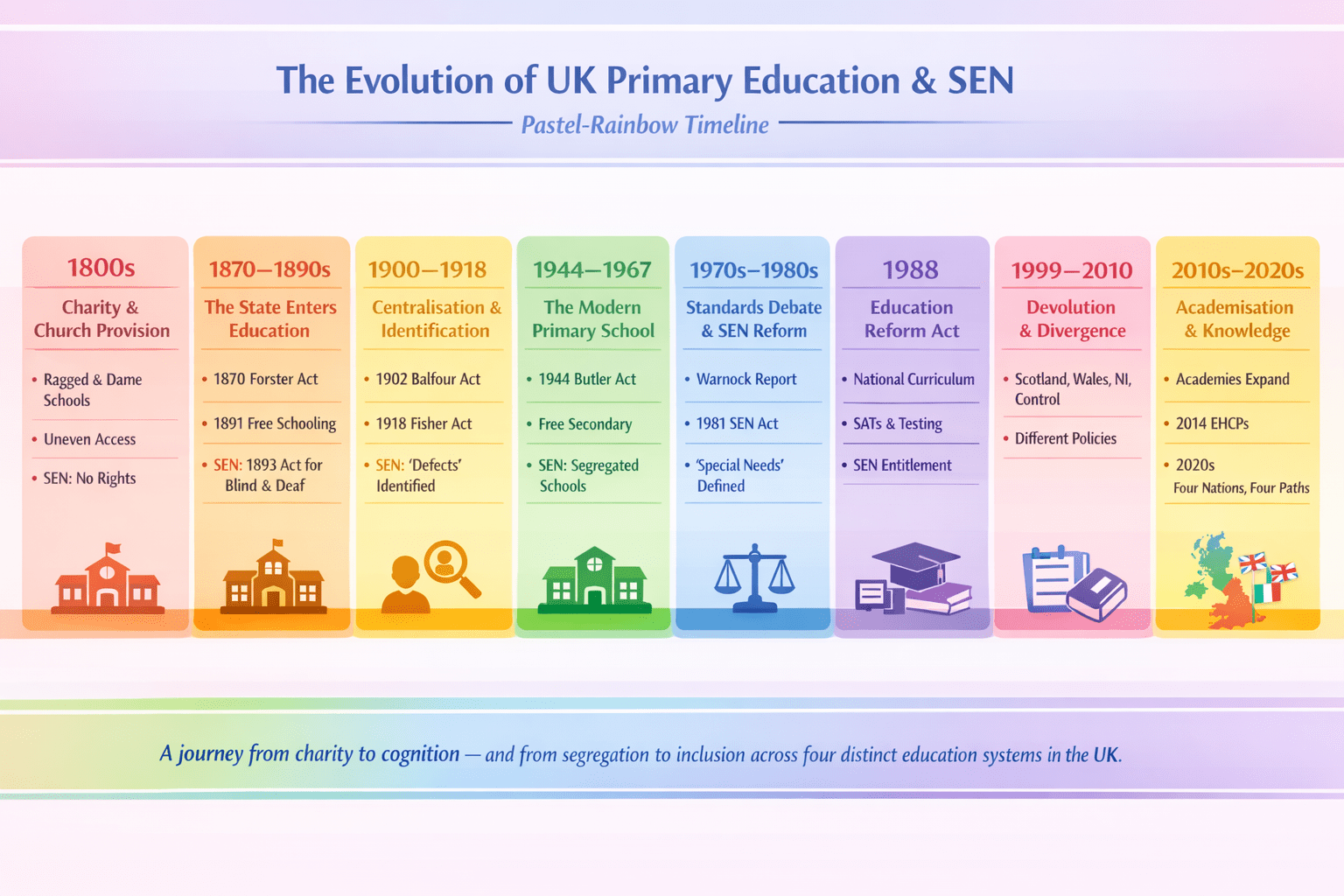
The following is based on a combination of AI trawls (from three different AI models) from ‘public-facing’ information on the internet. It may contain inaccuracies or particular biases depending on the information available, which it aggregates with no judgement made as to the relative merits of each article. It is also deliberately brief to make it easier to digest. As such it is a starting point for information and discussion rather than a finished article. It is skewed slightly at the end towards developments in England as that is where I teach. I leave developments in Scotland, Wales and Northern Ireland to colleagues there who have more knowledge and experience of their situation!
The ‘Concluding Thoughts’ section however is all my own personal opinion and is not AI generated.
Primary education in the United Kingdom has developed through a long sequence of social, political, and philosophical reforms. From its origins in charitable and religious schooling to the modern, state‑funded systems across the four nations, each era reflects shifting beliefs about childhood, citizenship, and the purpose of education. This article traces that development, explaining how the system evolved and why the child‑centred ideals of the 1967 Plowden Report ultimately gave way to the structured, standards‑driven framework established by the 1988 Education Reform Act — and how devolution later reshaped educational practice across the UK.
“Primary education in the UK shifted from a patchwork of private and religious schooling to a universal state system over roughly 150 years.”
“The 1988 Education Reform Act brought the biggest change to the daily life of a primary pupil.”
1. Before 1870 — Fragmented Provision and Unequal Access
Before the state became involved, education was inconsistent and largely dependent on local initiative. Dame Schools offered informal instruction, Ragged Schools provided charitable support for the poorest children, and Church Schools dominated provision through the National Society and British Society. Access varied widely by geography, wealth, and religious affiliation, creating the inequalities that later reforms sought to address.
Provision for children with disabilities was extremely limited. Support was largely charitable and separate from mainstream schooling, reflecting Victorian assumptions that such children required specialist institutions rather than inclusion.
2. 1870–1900 — The Birth of State Education
The 1870 Forster Act marked the beginning of systematic state responsibility for education. School Boards were established to build and manage schools where provision was inadequate. Compulsory attendance followed in 1880, and by 1891 elementary education had become effectively free through government fee grants. For the first time, the state accepted responsibility for ensuring universal access to schooling.
During this period, children with disabilities were still educated separately. The 1893 Elementary Education (Blind and Deaf Children) Act required School Boards to provide specialist schooling for blind and deaf pupils, marking the first statutory recognition of their educational rights. However, this legislation reinforced segregation rather than inclusion.
3. 1900–1944 — Centralisation and Administrative Reform
The 1902 Balfour Act replaced School Boards with Local Education Authorities (LEAs), creating a more coherent administrative structure. Throughout the early 20th century, publicly funded schooling expanded, teacher training improved, and education became increasingly recognised as a public good.
SEN provision also developed, though still within a segregated model. The 1918 Fisher Act extended compulsory education and required LEAs to identify children with “physical or mental defects,” leading to the expansion of special schools. The emphasis remained on categorisation and separation, reflecting early‑20th‑century medical models of disability.
4. 1944–1967 — The Modern Primary School and the Plowden Era
The 1944 Butler Act reshaped the structure of schooling and established the framework still recognisable today.
Key features of the 1944 Butler Act
- A formal division between Primary (5–11) and Secondary (11+) education, defining primary schooling as a distinct phase for the first time.
- The tripartite system of Grammar, Technical, and Secondary Modern schools, with placement determined by the 11‑Plus examination.
- Free secondary education for all pupils, ending the previous system of fees and scholarships.
- A new school‑leaving age of 15, implemented in 1947, replacing the previous limit of 14 set by the 1918 Fisher Act.
- A planned future increase to age 16, legislated for in 1944 but not enacted until 1972.
- Compulsory part‑time education for 15–18‑year‑olds, though implementation varied.
SEN developments under the Butler Act
The Act introduced the first comprehensive statutory framework for children with Special Educational Needs. It required LEAs to identify pupils with disabilities and categorise them into one of eleven “handicapped” groups. Although this system expanded provision, it reinforced segregation and medicalised understandings of disability. Most children with SEN were educated in separate special schools or units.
The Plowden Report (1967)
Plowden promoted:
- child‑centred learning
- discovery‑based pedagogy
- learning through play
- strong teacher autonomy
- local decision‑making
Its assertion that “at the heart of the educational process lies the child” captured the ethos of the period.
Plowden also advocated for greater integration of children with disabilities into mainstream primary schools where appropriate, anticipating later inclusion agendas. However, implementation was uneven and constrained by limited resources.
Why faith in Plowden declined — evidence and politics
By the late 1970s and early 1980s, concerns grew about inconsistent standards, uneven curriculum coverage, and declining literacy and numeracy outcomes. Some of these concerns were real but localised, often linked to uneven implementation and limited teacher training.
However, historians widely note that there was no national evidence of a systemic decline in standards. Instead, the loss of faith in Plowden was amplified by political and media narratives that portrayed progressive education as chaotic or ineffective.
This narrative aligned with a broader political shift toward centralisation, economic competitiveness, and measurable outcomes. As a result, Plowden became a symbolic target, criticised less for its actual recommendations and more for what it represented: autonomy, flexibility, and trust in teacher judgement — all of which conflicted with the emerging standards agenda.
5. 1988 — The Education Reform Act: A New Educational Settlement
The 1988 Education Reform Act (ERA) transformed primary education and marked a decisive break from Plowden’s child‑centred approach.
Key features
- National Curriculum defining what all pupils should learn
- Standardised testing (SATs) at ages 7 and 11
- League Tables comparing school performance
- Local Management of Schools (LMS) giving schools control over budgets
- Grant‑Maintained Schools reducing LEA influence
Philosophical shift
The ERA replaced teacher autonomy with centralised expectations, measurable outcomes, and national standardisation. It reflected a belief that educational quality could be improved through structure, data, and accountability rather than freedom and exploration.
SEN developments in the ERA era
The ERA coincided with a major shift in SEN policy. The 1981 Education Act, influenced by the Warnock Report (1978), had already replaced the 1944 categories with the modern concept of “special educational needs” and introduced the statutory “statement.” This marked a philosophical shift from segregation to integration, encouraging mainstream schools to accommodate a wider range of learners.
The ERA reinforced this by embedding SEN responsibilities within the National Curriculum framework, ensuring that children with SEN were entitled to access the same core content as their peers.
6. Devolution and Divergence (1999–Present)
The creation of devolved governments in Scotland, Wales, and Northern Ireland fundamentally reshaped education policy across the UK. While England continued along a path of accountability, testing, and academisation, the devolved nations pursued distinct philosophies.
Scotland
- Rejected SATs and league tables.
- Introduced Curriculum for Excellence (CfE), emphasising broad competencies and teacher professional judgement.
- Maintained a comprehensive system without academies.
- SEN provision framed through “Additional Support Needs” (ASN), a broader and more inclusive concept established by the 2004 Additional Support for Learning Act.
Wales
- Abolished SATs in the early 2000s.
- Introduced the Curriculum for Wales 2022, focusing on holistic development and progression steps.
- Emphasised equity and wellbeing over competition.
- Reformed SEN through the Additional Learning Needs and Education Tribunal (Wales) Act 2018, replacing statements with a unified ALN system.
Northern Ireland
- Retained academic selection in many areas.
- Adopted a revised curriculum emphasising skills, personal development, and cross‑curricular learning.
- SEN provision shaped by the Special Educational Needs and Disability (NI) Order 2005, strengthening inclusion and parental rights.
England
- Continued with SATs, OFSTED inspections, the National Curriculum, and large‑scale academisation.
- Emphasised phonics, mastery, and cognitive science.
- Reformed SEN through the Children and Families Act 2014, replacing statements with Education, Health and Care Plans (EHCPs) and extending support from 0–25.
Impact of devolution
Devolution created four distinct education systems, each reflecting different political priorities and educational philosophies. England emphasises standards and accountability, while Scotland and Wales emphasise teacher autonomy and holistic development. Northern Ireland maintains a hybrid model shaped by its unique political context.
7. 1990s–2020s — Inspection, Academisation, and Cognitive Science (England)
While the devolved nations moved away from high‑stakes accountability, England intensified it.
1990s
- OFSTED (1992) introduced regular inspections and published reports.
- Literacy and numeracy strategies standardised teaching sequences.
2000s
- Every Child Matters broadened the focus to wellbeing.
- Early expansion of academies.
2010s
- Rapid growth of Multi‑Academy Trusts (MATs).
- 2014 National Curriculum emphasised knowledge‑rich content and explicit instruction – but Academies do not have to follow this curriculum.
2020s
Strong influence of cognitive science, including:
- retrieval practice
- spaced learning
- mastery learning
SEN in the contemporary era
The SEND Code of Practice (2015 – replacing the one released in 2001) emphasised early identification, graduated support, and collaboration across education, health, and social care. However, rising demand, funding pressures, and uneven local implementation have created significant challenges, particularly in England.
Conclusion — From Charity to Cognition: A Four‑Nation Story
The history of primary education in the United Kingdom reveals a continuous tension between freedom and control, creativity and accountability, and local autonomy and national standardisation. From the charitable schools of the 19th century to the data‑driven academies of the 21st, each reform has reflected the social and economic priorities of its time.
SEN provision has followed a parallel trajectory: from segregated institutions in the 19th century, to categorisation under the 1944 Act, to integration after the Warnock Report, and finally to the inclusive frameworks now embedded across the four nations. Devolution has further diversified these approaches, with Scotland and Wales adopting broader, more holistic definitions of need.
In essence, the evolution of UK primary education is not a single story but four interwoven narratives, each blending compassion, structure, and evidence in different proportions to meet the changing needs of children and society.
References (APA 7th Edition)
BBC. (n.d.). History of education in the UK. https://www.bbc.co.uk
Beds Archives. (n.d.). Plowden Report archival materials. https://bedsarchives.bedford.gov.uk
British Parliament. (n.d.). Education legislation and fee grants (1891). https://www.parliament.uk
CPR Trust. (n.d.). Education Reform Act 1988 commentary. https://cprtrust.org.uk
Diplomat Magazine. (n.d.). Plowden Report overview. https://diplomatmagazine.com
Education‑UK. (n.d.). Development of elementary education. https://education-uk.org
Historic England. (n.d.). History of church schools. https://historicengland.org.uk
Hull History Centre. (n.d.). School board records. https://catalogue.hullhistorycentre.org.uk
IBOS School. (n.d.). The Butler Act and the 1944 Education Act. https://ibos.school
Kernow Learning. (n.d.). King Charles — historical education resources. https://www.kingcharles.kernowlearning.co.uk
LW Books Journals. (n.d.). Academies and governance. https://journals.lwbooks.co.uk
StudySmarter. (n.d.). Plowden Report summary. https://www.studysmarter.co.uk
Tandfonline. (n.d.). Historical analyses of education reform. https://www.tandfonline.com
White Rose ePrints. (n.d.). Education history research. https://eprints.whiterose.ac.uk
Wikipedia. (n.d.). Various entries on UK education history. https://en.wikipedia.org
Wired. (n.d.). Education policy and academisation. https://www.wired.com
Some Concluding Thoughts
The following represent my own opinions, not necessarily those of the school at which I currently work.
It would seem to me that, overall, the story of educational development in the United Kingdom is one of best intentions with attempts at promoting social mobility and justice. Unfortunately these were, at times, subject to questionable judgement calls and biases.
For example, in the 1970s and 1980s the more conservative side of the establishment pushed their agenda almost aggressively, bombarding the public with a narrative about the need for change to ‘improve standards’ with very limited evidence that this was the case – does this sound familiar? That is not to say that the changes taking place in this era were all bad. The revision in provision for pupils with Special Educational Needs, for example, was a welcome step forward – not perfect by any means but still an improvement on what went before.
Then came the step change of the National Curriculum in 1988, together with the rhetoric of ‘improving standards’. But how do you show this? Simple – you reduce everything to a number that can be recorded and compared each year. And in one fell swoop education became training children to perform in tests, and schools’ worth was measured in English and Maths (and Science for a good number of years) test scores. Over the years there have been various mechanisms to try to force schools to provide a ‘broad and balanced’ curriculum – OFSTED Deep Dives, for example – but it was your school’s performance in national tests that really mattered in the end. And anyone who questioned the validity of this ludicrous way of evaluating ‘performance’ was simply slandered as someone who wanted to dumb down education, ‘lower standards’ and generally take us back to the dark ages. The theory behind having a national curriculum, a nationwide offer that all children have access to no matter where they are from, is laudable in that it can be such a force for improved social mobility and justice. It is just a shame that it was – and continues to be – organised and implemented in such a way that it seems more a rod to beat schools with rather than a joy in which to revel. In my experience, teachers spend far more time trying to make the current iteration (with its academic skew) relevant to the lives of their children than they should have to.
Which brings us to ‘the one that got away’, the Rose review of 2009. This was set in motion by the Labour government of the time and lauded by employers and educators alike. But with the election of a new coalition government in the late Spring of 2010, it was dropped like a stone as it didn’t align with their much more narrow, conservative view of education. This was such a missed opportunity – a real chance to develop an offer more relevant to the needs of both the individual and society as a whole. But unfortunately, wasn’t seen as academic enough (what is this obsession with academic achievement being the ultimate goal of education? I will offer some thoughts on this in another missive). So it was replaced with a curriculum, introduced in 2014, that seemed more based on a ‘rose tinted specs’ view of a public school education from the post war years. In its defence the phrase ‘academic rigour’ was used almost like a weapon to beat ‘non believers’ into submission (or oblivion). However, in my opinion the many inadequacies of the 2014 curriculum were acknowledged by the fact that academies were not actually required to follow it. Schools were being encouraged to become Academies almost on an industrial scale, and ‘failing schools’, to borrow the tabloid phrase, were being forced to become Academies in order to ‘fix’ them. You have to wonder in the cases where this seemed to have the required effect, was it the curriculum freedom that ‘sorted’ them?
On the subject of Academies, one of the great under-reported stories is the cost to the education budget of the Academy system. Once upon a time there would be a small team at the Local Authority who would be responsible for the schools of the borough, say 50 primary and 10 secondary, and they would be on salaries comparable with the head teacher of a large secondary school. Now, each Multi Academy Trust (MAT) has a multilayered management team responsible for a much smaller number of schools but which in many cases consists of a number of individuals taking home high five- or six-figure salaries. This drains funds out of schools and into the pockets of the lucky candidates. Information from sources such as the Institute for Fiscal Studies suggests that Local Authorities cost £1 – £3 per pupil to cover their management responsibilities whereas in Multi Academy Trusts the equivalent figure is £10 – £25. Given that nearly 50% of primary schools are currently members of MATs, that represents a huge chunk of money that is not being spent on the children…
Going forward, will we ever escape from the tyranny of a traditional academic curriculum? Will education ever be seen as a means by which children can be readied for life, not just standardised testing in English and Maths? Will other areas of expertise be valued as highly? Real change is hard, takes vision, time, courage and trust as people are not machines – even though the current system of assessment and inspection treats them as such. Funnily enough, one of the things that may force a change is the rise of AI. This is now eating into entry level jobs in many industries that utilise ‘academic’ skills, for example those requiring literature surveys, financial analysis and report writing. But more practical tasks – construction, entertainment and the like – still require human input. At some point a curriculum to reflect this will be vital for the future prospects of our children. Why not start that journey now?
Mike
Please like 👍 and share this post with your friends.
To contact me regarding this post, or purchasing/performing/commissioning music for any occasion, please email me at
contact@mikestubbscomposer.com

